Glossary
Orthodontic words, plainly.
The words you will hear at the chair, from overjet to debond, each in a sentence or two you can use. If we ever use one we have not explained, stop us and ask.
A
- Adjustment
- The regular visit during braces, every six weeks or so here, when the wire is checked or changed, new ties go on and Dr. Omerza checks the progress. It takes about twenty minutes. Living with braces →
- Aligner
- A clear, removable plastic tray made from a scan of the teeth; each tray in the series moves the teeth a little further. Worn 20 to 22 hours a day, aligners suit many mild to moderate problems. Invisalign and clear aligners →
- Archwire
- The wire that runs through the brackets and does the steering. Treatment usually starts with a thin, flexible wire and moves to stiffer ones as the teeth line up.
- Attachment
- A small tooth-coloured bump bonded to a tooth so that an aligner has something to push against. Attachments are polished off when treatment ends.
B
- Band
- A thin steel ring cemented around a back tooth to anchor an expander, a corrector, a lingual arch or the end of the archwire. Separators and bands →
- Bonding
- Fixing brackets, a retainer wire or aligner attachments to the teeth with a dental adhesive. The braces-on appointment is a bonding appointment.
- Bracket
- The small square, metal or tooth-coloured, bonded to each tooth to hold the archwire. Some carry hooks for elastics. Braces →
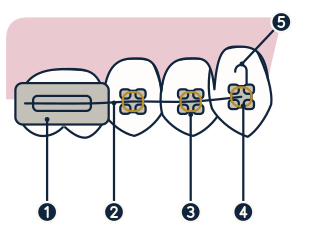
What is on the teeth, from the back of the mouth forward. - Band: a thin steel ring cemented round a back tooth, with a tube for the end of the wire.
- Archwire: the springy wire that does the steering.
- Bracket: the small square bonded to each tooth.
- Tie: the little elastic ring that holds the wire in the bracket, the part you pick colors for.
- Hook: where a rubber band (an elastic) attaches.
C
- Cephalometric X-ray
- A side view of the head on one X-ray, showing how the jaws and teeth line up with each other and with the skull. Taken when the plan needs it, not at every exam.
- Class I
- The back teeth meet front to back the way they should. A Class I bite can still be crowded, spaced or crossed; the class describes only how the upper and lower molars line up.
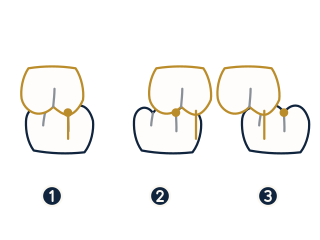
The class describes only how the first molars meet, front to back. - Class I: the upper molar's front cusp lands in the lower molar's groove.
- Class II: the upper molar sits ahead of the groove, the lower one behind.
- Class III: the upper molar sits behind the groove, the lower one ahead.
- Class II
- The lower teeth sit behind the upper ones, usually because the lower jaw is behind the upper. The upper front teeth often stick out, and most people call it an overbite. Class II bites →
- Class III
- The lower teeth sit ahead of the upper ones, because the lower jaw is long, the upper jaw is short or set back, or both. When the lower front teeth close in front of the upper ones, it is an underbite. Class III bites →
- Crossbite
- Upper teeth that bite inside the lower ones instead of outside them, at one tooth, on one side or on both. Often the upper jaw is narrow, which is easiest to put right while a child is still growing. Crossbites →
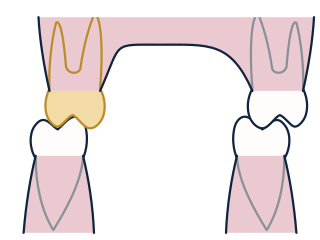
Right: as it should be. Left: the upper molar bites inside the lower one, often because the upper jaw is narrow. - Crowding
- Too little room for the teeth, so they overlap, turn or are pushed out of line. The classic reason for braces. Crowding →
D
- Debonding
- Taking the braces off: brackets and bands removed, the adhesive polished away, and impressions or a scan taken for the retainers. Usually the happiest appointment of the lot.
- Decalcification
- Minerals drawn out of the enamel surface where plaque sits against a tooth for too long. The first sign is a chalky white spot. White spot lesion →
- Diastema
- A gap between two teeth, most often between the upper front pair. Braces or aligners close it, and a retainer, sometimes a thin bonded wire, keeps it closed.
- Digital scan
- A 3-D model of the teeth made with a small hand-held camera wand instead of a tray of impression material; also called a digital impression. Aligners, retainers and appliances can be made from it, and reviews of the research find it clinically accurate. What a 3-D scan changed →
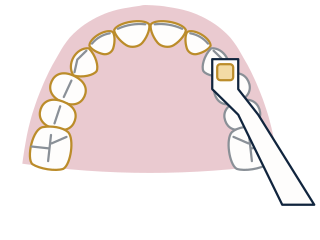
Seen from below: the teeth outlined in color are already on the screen as a 3-D model.
E
- Elastics
- Small rubber bands hooked between the upper and lower braces to correct how the teeth meet. They work only when they are worn as prescribed. Elastics →
- Eruption
- A tooth coming through the gum into the mouth. Eruption problems are teeth that arrive late, in the wrong place, or not at all.
- Expander
- An appliance fixed to the upper back teeth with a screw in the middle; turned at home with a key, it widens a narrow upper jaw in a growing child. Also called a palatal expander. Palatal expanders →
- Extraction and non-extraction treatment
- Whether a plan removes some teeth, usually premolars, to make room, or makes room without removing any. Taking teeth out without braces to manage the spaces rarely helps. Why pulling teeth alone rarely helps →
H
- Habit appliance
- A small wire fence behind the upper front teeth that reminds a thumb or a tongue to stay out of the way while an open bite closes. Also called a tongue crib. Habit appliances →
- Headgear
- An appliance worn outside the mouth, at home and in bed, that hooks to the upper molars to guide a growing child's jaws. Reverse-pull headgear, or a facemask, brings a short upper jaw forward. Headgear →
- Herbst appliance
- A fixed rod-and-tube hinge on each side, attached to the back teeth, that holds the lower jaw forward while a child grows, to correct a large overbite (a Class II bite). Class II correctors →
I
- Impacted tooth
- A tooth stuck in the bone or gum that cannot come in on its own, most often an upper canine. An oral surgeon can uncover it and bond a small attachment, and the braces then guide it down. Impacted canines →
- Interceptive treatment
- Early treatment that heads off a developing problem, such as a crossbite, a habit or a blocked tooth, so that later treatment is simpler or unnecessary. Interception is part of the specialty's official definition.
- Interproximal reduction (IPR)
- Smoothing a fraction of a millimetre of enamel from the sides of teeth where they touch, to make a little room or reshape a contact. Often part of aligner treatment.
L
- Ligature
- The small elastic tie, or fine wire, that holds the archwire in each bracket. The colours you pick are the ligatures, changed at every visit.
M
- Malocclusion
- Any departure from a good bite: crowding, spacing, an overbite, an underbite, a crossbite or an open bite. The American Dental Association defines orthodontics as the specialty that includes "the diagnosis, prevention, interception, and correction of malocclusion."
- Midline
- The line between the two upper front teeth, and between the two lower ones. Dr. Omerza measures how far each sits from where it should, in millimetres.
- Mouthguard
- A soft guard worn over the teeth for sports. With braces, the American Association of Orthodontists calls one "not only possible but strongly recommended". Mouthguards and braces →
O
- Open bite
- The front teeth do not meet when the back teeth do, leaving a gap you can see through. A thumb or tongue habit often keeps it open; some come from the way the jaws grew. Open bites →
- Orthodontist
- A dentist who has completed at least two more years of graduate training in orthodontics at an accredited program after dental school. The specialty's full name is orthodontics and dentofacial orthopedics: straightening teeth, and guiding the growth of the jaws. Why an orthodontist →
- Orthognathic surgery
- Jaw surgery, by an oral and maxillofacial surgeon, for jaws mismatched by more than moving teeth can disguise. It is done once growth has finished, with braces before and after. Cases that need jaw surgery →
- Overbite
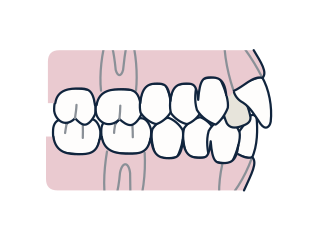
- How far the upper front teeth overlap the lower ones from top to bottom; Dr. Omerza records it as a percentage. People often say 'overbite' when they mean overjet.
- Overjet
- How far the upper front teeth stick out ahead of the lower ones, measured in millimetres. A large overjet puts the front teeth at risk in a fall or from a ball.
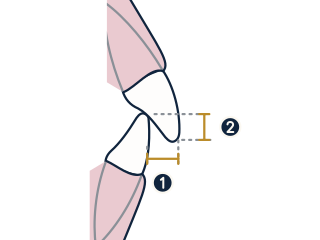
Two measurements people mix up: one front to back, one top to bottom. - Overjet: how far the upper front teeth sit ahead of the lower ones.
- Overbite: how far the upper front teeth overlap the lower ones.
P
- Panoramic X-ray
- A single X-ray that sweeps around the head and shows every tooth, including the ones still forming under the gums, and both jaws. Dr. Omerza takes one at a first visit unless your dentist has a recent one; it is digital, with a lead apron and thyroid collar every time. Why an X-ray at seven →
- Permanent teeth
- The adult teeth: 32 of them, counting the four wisdom teeth.
- Primary teeth
- The baby teeth, 20 in all. As well as chewing, they hold the space for the adult teeth. "Around age 7, children have a mix of baby (primary) and permanent teeth," as the American Association of Orthodontists puts it.
R
- Relapse
- Teeth drifting back toward where they started after treatment. Teeth shift throughout life, which is why retention is for life. Retainers →
- Retainer
- What holds the teeth after braces or aligners. A Hawley retainer is a removable acrylic plate with a wire across the front teeth; a clear retainer is a thin, removable plastic shell over every tooth; a bonded retainer is a thin wire glued behind the front teeth, where it stays. Retainers, and the rest of your life →
- Retention
- The phase after the braces come off, when retainers hold the result. Here that means checks at one month and then once a year.
S
- Separators
- Small elastic rings placed between the back teeth to make room for bands. They make the teeth feel tight for a day or two. Separators and bands →
- Space maintainer
- An appliance, often a wire behind the teeth, that holds the gap left by a baby tooth lost early, so that the adult tooth still has room. Space maintainers →
- Spacing
- Gaps between the teeth, from teeth that are small for the jaw, a missing tooth, or a habit pushing the front teeth apart. Spacing →
- Succedaneous teeth
- The adult teeth that replace baby teeth: the incisors, canines and premolars. The adult molars come in behind the baby teeth and replace none. Dr. Omerza's letters often tie the start of treatment to the eruption of all the succedaneous teeth.
T
- TAD (temporary anchorage device)
- A tiny screw placed in the jaw bone to give braces a fixed point to push or pull against, and removed when that job is done. In a 2018 review of 46 studies, about 13.5 percent loosened before their work was done.
- Two-phase treatment
- An early phase while a child is still growing (an expander, a habit appliance, sometimes a few braces), a rest, then a second phase once most or all of the adult teeth are in. Many problems can be treated in a single phase; for prominent front teeth, an early phase reduces injuries to them but showed no other advantage in the Cochrane review.
W
- White spot lesion
- A chalky white mark on the enamel where plaque sat long enough to draw minerals out of it. In the American Association of Orthodontists' words, braces do not "create" these spots on their own; plaque does, which is why the brushing matters. Brushing and flossing with braces →
The appliances, explained
Expanders, correctors, space maintainers, elastics: what each does and how it feels.
Read moreThe kinds of cases we treat
Crowding, bites, stuck canines and the rest, in plain words.
Read moreQuestions & answers
Cost, timing, braces or aligners, and everything else people ask.
Read moreStill a word short?
Ask at the free first visit. Dr. Omerza would rather explain a term twice than have you nod along.
Office hours
| Monday – Friday | 8 am – 5 pm |
|---|---|
| Saturday – Sunday | Closed |
4412 Whipple Ave NW, Canton · Near Belden Village, off I-77 at exit 109