(330) 492-7920
Omerza Orthodontics The Brace Place · Canton

Appliances

The appliances, explained.

Braces and aligners move teeth. The rest of the hardware has narrower jobs: widening a jaw, guiding growth, holding a space, breaking a habit. Here is each one: what it does, who gets it, how it feels, and how long it stays, where we can honestly say.

The upper teeth and palate seen from below with an expander: bands on the back teeth, arms to a screw in the middle of the palate, and arrows pointing outward.

Seven kinds

Each one has one job.

Separators, bands and elastics come with braces. The rest are for particular problems at particular ages, and most children never need them; whether yours does is what the free first visit is for.

Palatal expander

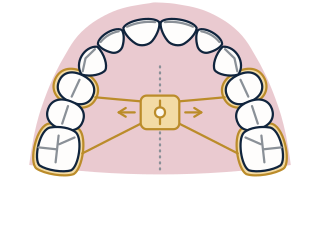
The upper teeth and palate seen from below with an expander: bands on the back teeth, arms to a screw in the middle of the palate, and arrows pointing outward.
Seen from below: the screw sits over the seam down the middle of the palate; the arrows show which way the halves go.
What it does
Widens a narrow upper jaw. The upper jaw is two halves that meet in a seam down the middle of the palate; in a growing child, the screw in the middle of the expander eases them apart a little at a time, so the upper teeth fit around the lower ones and crowded teeth find room. A quad helix, a springy wire with four coils behind the upper teeth, does a similar job with spring pressure instead of a key.
Who gets it
Children with a crossbite or a narrow upper jaw, while the jaw still widens readily. In adults the seam has fused; an expander anchored to small bone screws can now open it for many, though the long-term evidence is still young.
The turns
At home, a parent turns the screw with a small key, on a schedule Dr. Omerza writes down for your child; each turn opens it by a fraction of a millimetre. When the jaw is wide enough, the turning stops and the expander stays in for a while to hold the new width.
The gap
As the jaw widens, a gap opens between the upper front teeth. It looks alarming and it is the sign the expander is working. It usually closes by itself afterwards, or the braces close it later.
The first weeks
In the first days of turning: pressure on the teeth, sometimes felt up toward the nose, extra saliva, and a lisp while the tongue gets used to the new furniture. Food packs around it, so rinse and brush after eating. Soreness is handled the way it is after a braces adjustment.

Herbst appliance and Forsus spring

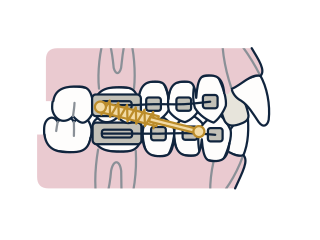
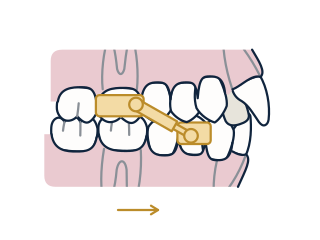
Side view of the teeth with a Herbst appliance: a tube fixed at the upper first molar and a rod fixed at a lower premolar, sliding into it, and an arrow showing the lower jaw held forward.
Tube on the upper molar, rod on a lower premolar, a pair on each side; the arrow is the lower jaw held forward.
Side view of teeth in braces with a spring running from the upper first molar down to the lower wire just behind the canine.
The spring runs from the upper molar's tube to the lower wire, just behind the canine.
What they do
Fixed Class II correctors, for a bite where the upper teeth sit well ahead of the lower, usually because the lower jaw is behind. A Herbst has a rod-and-tube hinge on each side, fixed to the back teeth, that holds the lower jaw forward. A Forsus spring is a coil spring on each side that works with braces, pushing the lower teeth forward and the upper ones back. Being fixed, both work day and night without anyone having to remember them.
Who gets them
Growing children and young teens, while growth can help, which usually means around the time the last baby teeth go. Earlier only when the front teeth stick out far enough to be at real risk from a fall or a ball: fewer injured front teeth is the one benefit of an early start that the clinical trials have shown.
How they feel
For the first week, cheeks rub and chewing feels clumsy; wax and soft food help, as they do with new braces. Opening wide takes practice.
Eating with them
Once you are used to it, eat as you would with braces: cut food small, and skip the hard and sticky list on the care page. Brush around the rods or springs after every meal. If a rod, a spring or a band comes loose, call in office hours: it is rarely an emergency, but it is not working until it is fixed.
How long
Dr. Omerza tells you at the start how long your child's corrector should stay in, and checks its progress at every visit.

Headgear and reverse-pull headgear

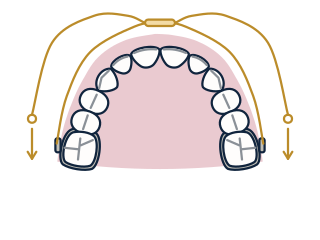
The upper teeth seen from below with a facebow: an inner wire hooked into tubes on the upper molar bands, an outer wire running back on both sides, and arrows showing the strap pulling back.
Seen from below: the inner bow fits tubes on the molar bands, and the strap pulls the outer bow back, the way the arrows point.
What they do
Headgear is worn outside the mouth: a facebow hooks to bands on the upper molars, and a strap goes behind the neck or over the head, to hold back the upper teeth and jaw while a growing child's lower jaw catches up. Reverse-pull headgear, or a facemask, works the other way round: it rests on the forehead and chin, and elastics to the upper teeth bring a short upper jaw forward.
When
Headgear is on Dr. Omerza's list of options for the growing child it suits. Reverse-pull headgear is for the uncommon young child whose upper jaw is behind the lower, often together with an expander, and it works only while that child is still growing.
Living with it
Pressure on the teeth for the first days. It is worn at home and in bed, not at school, for a limited season.

Space maintainers

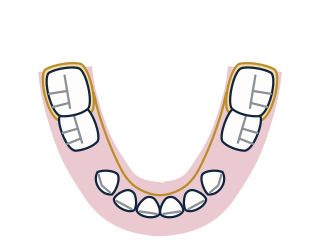
A child's lower teeth seen from above, with bands on the first molars and a thin wire behind the front teeth; on each side a baby molar is missing and its space is kept open.
Seen from above: the wire runs behind the front teeth from band to band; the gap on each side is a lost baby molar's room.
What they do
When a baby molar is lost early, to decay or an accident, the teeth behind it drift forward and the adult tooth can find its space gone. A space maintainer holds the gap. A lower lingual arch is a thin wire behind the lower teeth, fixed to bands on the molars; a Nance holds the upper molars with a wire and a small acrylic button against the palate.
Who gets them
Children who lose baby molars early, or whose adult teeth need every millimetre of room saved. The AAO lists lingual arches among the appliances of early treatment.
Living with them
The tongue explores it for a few days and then ignores it. Skip sticky sweets, which can pull a band loose, and tell us if anything moves.
How long
Until the adult teeth it is saving room for have come in.

Habit appliance (tongue crib)

What it does
A small fence of wire behind the upper front teeth, fixed to bands on the molars. It reminds a thumb, a finger or a tongue to stay out from between the front teeth, so that an open bite can close.
Who gets it
Children whose thumb, finger or tongue habit is reshaping the bite. A tongue crib is one of the early-treatment appliances the AAO lists; a speech pathologist or myofunctional therapist sometimes helps retrain the tongue as well.
Living with it
Speech and swallowing feel odd for the first few days. It is a reminder, not a punishment.
How long
Until the habit has gone and the bite has started to close; Dr. Omerza decides when.

Separators and bands

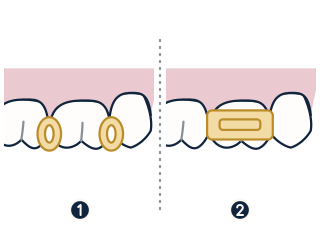
Two side views of the upper back teeth: small elastic rings between the first molar and its neighbors (1), and a steel band round the molar (2).
The rings open a sliver of room; then the band takes their place.
  1. Separators: small elastic rings between the teeth.
  2. A band: a thin steel ring cemented round the molar.
What they are
Separators are small elastic rings pressed between the back teeth to open a sliver of space for a band. A band is a thin steel ring cemented around a molar, anchoring an expander, a corrector, a lingual arch or the end of the archwire.
When
Separators go in at the records visit when bands will be needed, and come out when the bands go on, usually within about two weeks.
How they feel
The back teeth feel tight and tender for a day or two after the separators go in; soft food helps. If one falls out early, call, because it may need replacing. If a band comes loose, leave it alone and call; do not try to put it back.

Elastics (rubber bands)

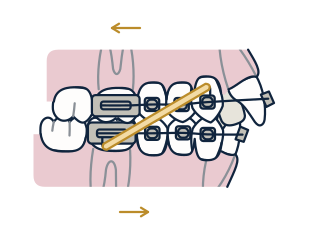
Side view of teeth in braces with a rubber band from a hook at the upper canine to a hook on the lower first molar, and arrows: upper teeth back, lower teeth forward.
Upper canine hook to lower molar hook. The arrows show the pull: upper teeth back, lower teeth forward.
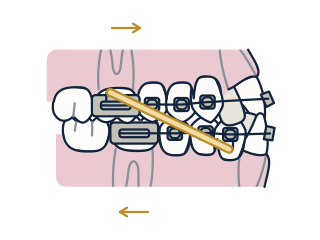
Side view of teeth in braces with a rubber band from a hook at the lower canine to a hook on the upper first molar, and arrows: upper teeth forward, lower teeth back.
Lower canine hook to upper molar hook: the pull runs the other way.
What they do
Small rubber bands hooked between the upper and lower braces to pull the bite into line. Braces straighten each arch; elastics fix how the two arches meet, which braces alone cannot do.
The part only you can do
Wear them for as many hours as Dr. Omerza prescribes, and change them as often as we say, because they lose their stretch. Carry spares, and call us if you run out. In the words of the AAO's consent form, treatment time "may be lengthened if ... patient cooperation is not adequate."
How they feel
The teeth are tender for the first few days. Keep wearing them and it passes; stop and start, and it comes back each time.
When to stop
Only when Dr. Omerza says so.

What hurts, and for how long

Honestly: the first few days with anything new are the worst. The American Association of Orthodontists describes "pressure or tenderness for a few days after braces are first placed or adjusted," and the same goes for an expander, a corrector or a fresh set of elastics. "Rinsing with warm salt water or taking an over-the-counter pain reliever usually helps": half a teaspoon of salt in eight ounces of warm water. Wax handles anything that rubs. If it is no better after a few days, call.

A broken or loose appliance is rarely an emergency; call in office hours. Go to emergency care for sudden, severe pain with facial swelling or a fever, a jaw that may be broken, or a knocked-out adult tooth. And do not keep wearing an aligner or retainer that is sharp, painful or badly distorted. The emergencies page has the first aid.

How long, honestly

Where there is a number we can stand behind, we give it. For braces, Dr. Omerza's own figure: most patients complete active treatment in 18 months or less, and many simple problems are treated in 12 months or less. The AAO says mild crowding or spacing "can often be resolved in eight to twelve months, while more complex bite issues may take a couple of years."

For the appliances on this page, how long each stays depends on the child, the problem and the growth, so we do not print a number; Dr. Omerza gives you one at the start and keeps you posted at every visit. The appointments that move things along come about every six weeks.
The three you have heard of

Braces, aligners and retainers.

Sources

The appliances themselves: Dr. Omerza's exam form and the Canton office's schedule (2015–2016). Early-treatment appliances, two-phase treatment, soreness, emergencies, cooperation and treatment length: the American Association of Orthodontists (2024–2026). Early treatment and front-tooth injuries: the Cochrane review (2018). Expansion with bone screws in adults: Kapetanović and colleagues (2021).

Wondering whether your child needs one?

Most children never need an expander or a corrector. The free first visit tells you which, if any, and when.

Office hours

Monday – Friday8 am – 5 pm
Saturday – SundayClosed

4412 Whipple Ave NW, Canton · Near Belden Village, off I-77 at exit 109