Living with braces
The practical page.
Everything we tell you at the braces-on visit, written down for the day you cannot remember it. Food, brushing, soreness, sports, band, aligners, and the thing about white spots.
Food
What to eat, and what to skip.
The rule behind the list: anything hard enough to bend a wire or sticky enough to pull a bracket off costs you a repair visit and a few weeks of progress. Everything else is fine, in smaller pieces at first.
Skip these
- Hard candy, jawbreakers
- Caramel, taffy, gummies
- Popcorn
- Nuts
- Ice and popsicles (don't bite them)
- Hard pizza crust, bagels
- Fritos, Doritos, pretzels, hard tacos
- Sticky gum (sugar-free is fine)
- Whole apples, carrots
- Corn on the cob
- Ribs and wings off the bone
- Pen caps, fingernails
Go ahead
- Pasta, rice, soft bread
- Soup, stew, chili
- Eggs, fish, chicken (off the bone, cut up)
- Soft fruit; apples and carrots sliced
- Yogurt, cheese, ice cream
- Cooked vegetables
- Pancakes, muffins
- Smoothies
- Soft tacos, burritos
- Pizza, crust and all, cut small
The first few days: soft and cold. Smoothies, yogurt, mashed potatoes, soup, ice cream (medicinal).
Why we nag: the average patient breaks about three brackets over a course of treatment, and each one is a repair visit and a few weeks lost.
Brushing and flossing
Braces give plaque a thousand new places to hide, and plaque left against enamel for months leaves permanent white marks: not caused by the braces, caused by what was allowed to sit around them. The routine that prevents it:
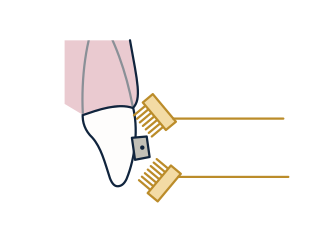
- Brush after every meal, two minutes, with fluoride toothpaste. Angle the bristles above and below the brackets, not just across them. An electric brush helps (we sell Sonicare brushes at a reduced cost); keep a travel brush in the bag, the desk and the car; the brushing station in our office is there for the after-lunch appointment.
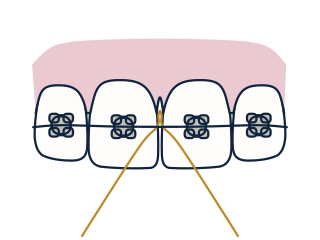
- Floss once a day, under the wire. A floss threader or orthodontic flossers make it a two-minute job rather than a twenty-minute one; a water flosser helps but does not replace floss.
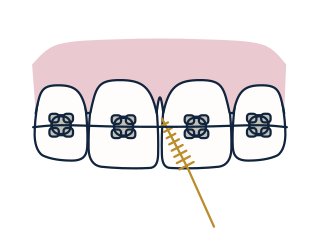
- Interdental brushes (the little Christmas trees we give you) for under the wire and around each bracket, whenever you have a minute.
- A fluoride rinse at night, after brushing, for the whole course of treatment.
- Keep your dental cleanings every six months. Braces make them more important, not less.
We check the brushing at every visit and we say so plainly when it is slipping, because by the time the marks show it is too late to prevent them.
The sore-day kit
- Tender teeth for a few days after braces go on and after adjustments. Soft food; a warm salt-water rinse (half a teaspoon of salt in a cup of warm water); ibuprofen as the package directs, which for the first adjustments, when the teeth move furthest, usually means every six hours for a day or two. Sugar-free gum, oddly, helps too. It passes.
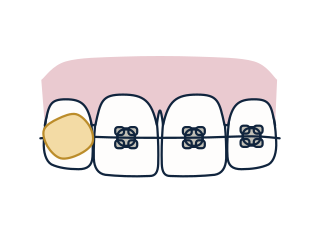
- A bracket rubbing the cheek or lip. Dry the spot, press a pea of orthodontic wax over the bracket. Swallowing wax is harmless. The mouth toughens up in a week or two and the wax retires. You go home with a starter kit of wax, brushes and elastics; wax refills are free, forever.
- A sore that has formed. Rinse with half hydrogen peroxide, half water, four to six times a day; it heals in days instead of a week. Wax over the bracket that caused it.
- A poking wire. Push it flat with a clean pencil eraser or a cotton swab; if it will not move, wax it, and call us.
- A loose bracket. Leave it, wax it if it bothers you, and call: it is not urgent but it is not doing its job either.
- Anything still hurting after a few days, or swelling, or a fever: call. See emergencies for the full list and what to do first.
Sports and band
Play everything. Wear a mouthguard made to fit over braces (the "boil and bite" kind sold for braces works; we also fit them in the office), because a knock to the face with brackets on cuts lips badly. Brass and woodwind players adapt within a week or two; wax on the front brackets helps at first, and a lip protector from the music store helps more.
Aligner care
- Wear them twenty to twenty-two hours a day. Out for eating, for anything but water, and for brushing; in for everything else, including sleep.
- Brush and floss before they go back in. A tray over an unbrushed tooth is a sugar bath.
- Rinse them in cool water and brush them gently with a soft brush and no toothpaste (it scratches). Never hot water; it warps them.
- Case, always. A napkin on a restaurant table is how trays end up in the trash. Keep the previous set as a spare.
- Change trays on the schedule we give you, usually weekly, and bring the current set to every visit.
Elastics (rubber bands)
If Dr. Omerza prescribes elastics, they are not optional and they are not decorative: they are doing the bite correction that the braces alone cannot. Worn as directed, they work; worn "mostly", they add months. Change them as often as we say (usually several times a day), carry spares, and call us if you run out. More on elastics, and on the other appliances.
The other thing that is not optional: the appointments, about every six weeks. Kept on schedule, they are the single biggest reason a case finishes on time.
Retainers, afterwards
The braces come off and the retainers go in: full time for the first two weeks (out only to eat, drink and brush), then every night. We see you a month after the braces come off and then once a year; after years of faithful wear Dr. Omerza starts tapering the nights.
- Tight retainer? The teeth have drifted. Wear it more (a few extra hours in the evening for a small shift, around the clock for a big one) and call us; an adjustment, and sometimes a little help from another appliance, usually brings things back.
- Cleaning. Brush it with toothpaste when you brush your teeth, or soak it in cold water with a retainer or denture cleaner. Never hot water (it is heat-formed and warps) and never household cleaners (it absorbs them). A vinegar soak softens the hazy yellow build-up so it brushes off.
- The case, always. The two ways retainers die: wrapped in a napkin and thrown out, and the dog. If you need a replacement, ask us for the current fee.
Everything about retainers: the three kinds, the checks, bonded wires and flossing, and the questions people ask.
Something we didn't cover?
Call or text the office. If it is after hours, the same number reaches us for anything that cannot wait.
Office hours
| Monday – Friday | 8 am – 5 pm |
|---|---|
| Saturday – Sunday | Closed |
4412 Whipple Ave NW, Canton · Near Belden Village, off I-77 at exit 109