Braces
Braces, the dependable way to a straight smile.
Smaller, lighter and more comfortable than the ones you remember, and still the most versatile appliance there is. Metal with a colour of your choosing, or ceramic that all but disappears.
What braces are, in one paragraph
A bracket is bonded to each tooth and a thin, springy wire runs through them all. The wire wants to return to its ideal arch shape, and as it does, slowly, it carries the teeth with it. Every six to ten weeks we change or adjust the wire, and the teeth follow. That is the whole trick: gentle, continuous pressure, applied by a specialist who knows how much is enough and where the roots and the bone will allow it.
Today's brackets are about half the size of the ones from the eighties, and modern nickel-titanium wires push with far lighter force, which means less soreness and fewer visits. Most patients at The Brace Place finish active treatment within eighteen months; simple cases often in about a year.
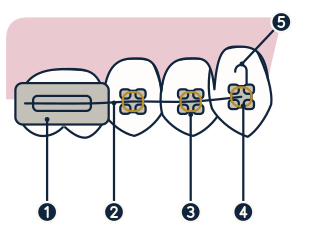
- Band: a thin steel ring cemented round a back tooth, with a tube for the end of the wire.
- Archwire: the springy wire that does the steering.
- Bracket: the small square bonded to each tooth.
- Tie: the little elastic ring that holds the wire in the bracket, the part you pick colors for.
- Hook: where a rubber band (an elastic) attaches.
Who braces are for
Almost everyone. Braces handle the full range: crowding, spacing, rotated teeth, overbites and underbites, crossbites, open bites, and the growth-guiding work that children sometimes need. They work regardless of whether the patient remembers to wear them, which is why they remain the first choice for most kids and many teens. And they are what Dr. Omerza reaches for when a case needs teeth moved bodily, or rotated a long way, or a bite corrected substantially, because for those jobs braces are still more predictable than aligners.
Metal braces
Stainless steel, small and smooth. The strongest, the least likely to break, and the one that lets you pick colours at every visit (or none). Most kids and teens, and plenty of adults who want the fastest, surest route.
Clear (ceramic) braces
Tooth-coloured brackets that do everything metal does from a conversational distance, invisibly. Slightly bulkier and more fragile, so we may suggest metal on the lower teeth. The usual choice for high-schoolers and adults who want braces without the look.
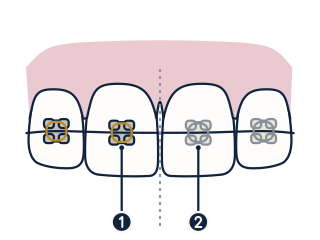
- Metal brackets, with colored ties.
- Clear (ceramic) brackets, with clear ties.
What a full fee covers
- Records: photos, scan or X-rays, and the plan
- The braces themselves and every adjustment visit
- Repairs for the ordinary mishaps
- Removal, and your first set of retainers
The journey
Start to finish.
- 1
Free consult
Exam, photos, a scan or X-rays as needed, and the plan with the price on it. About forty-five minutes.
- 2
Braces on
One visit of about an hour. Painless. A few days of tender teeth and soft food, then you forget they are there.
- 3
Adjustments
Every six to ten weeks, twenty to thirty minutes. New wires, new colours if you like, and an honest progress report.
- 4
Braces off
The best appointment of all. Retainers the same day, and a plan for keeping the result.
Questions
About braces.
Metal or clear: is one faster?
No. In most cases there is no difference in treatment time between metal and ceramic brackets; the wires do the moving and the wires are the same. Ceramic brackets are a little bulkier and a little more fragile, which is why we sometimes suggest metal on the lower teeth, where the upper teeth bite against them.
Do clear braces stain?
The ceramic itself does not. The tiny elastic ties that hold the wire can pick up colour from coffee, tea, curry or mustard between visits; they are replaced at every adjustment, so the slate is wiped clean every six to ten weeks. Clear ties on the upper front teeth and silver ones elsewhere is a common compromise.
How long are the appointments?
Putting braces on takes about an hour and does not hurt. Adjustments every six to ten weeks take twenty to thirty minutes; we keep after-school slots for them. Taking them off takes about an hour too, and that visit ends with your retainer.
Can I still play an instrument or a sport?
Yes to both. Brass and woodwind players adapt within a week or two (wax helps at first). Athletes wear a mouthguard made for braces; we fit them here, and the American Association of Orthodontists calls one "strongly recommended".
Invisalign & clear aligners
Nearly invisible, removable trays. When they are the right tool, and when they are not.
Read moreLiving with braces
What to eat, how to brush, what to do about a sore spot. The practical page.
Read moreYour first visit
Forty-five minutes, free, and you leave with a plan.
Read moreReady when you are.
Your first visit is free: an exam, a conversation, and a clear plan with the price on it. No pressure, no obligation.
Office hours
| Monday – Friday | 8 am – 5 pm |
|---|---|
| Saturday – Sunday | Closed |
4412 Whipple Ave NW, Canton · Near Belden Village, off I-77 at exit 109